Summer 2026 poses challenges for viewing planets, due to less-than-dark dawn skies and a shallow ecliptic angle.
Despite this, Saturn improves throughout July, transitioning toward a great upcoming observational window.
More advice
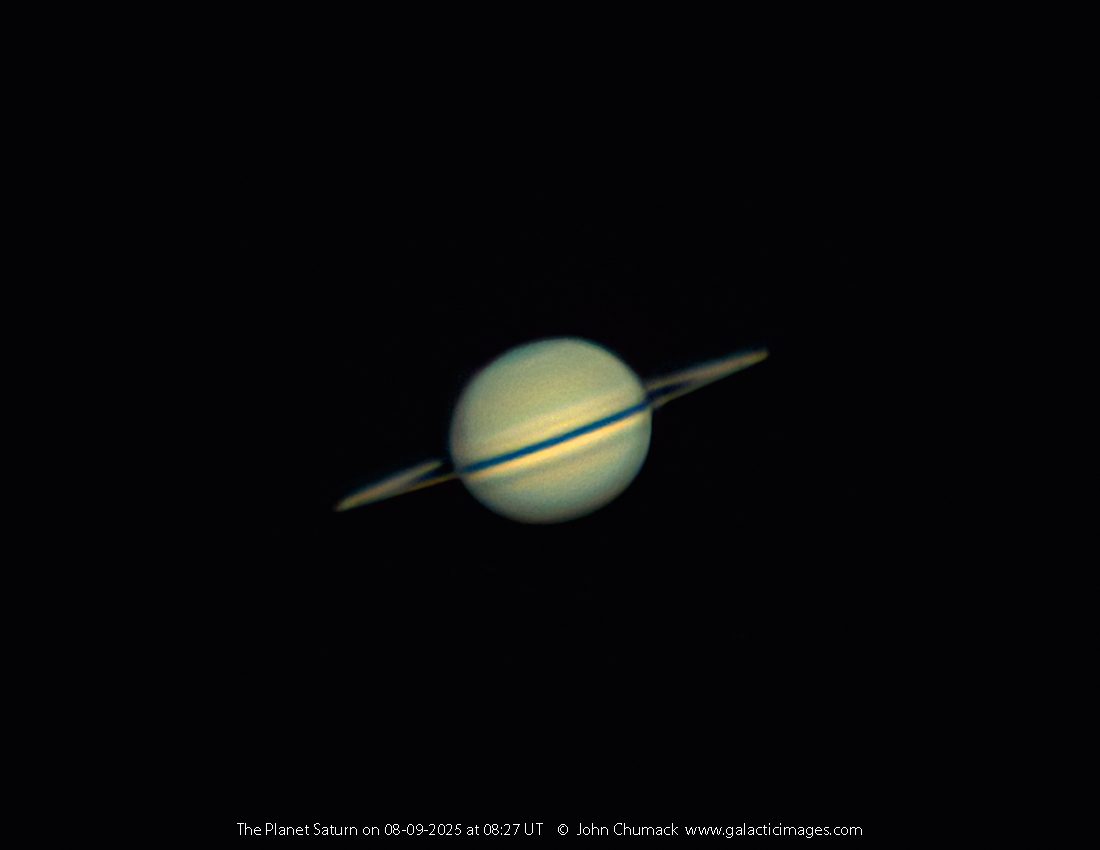
Saturn's 2026 timeline
- Start of July: Saturn shines at magnitude +0.7 but is barely visible above the eastern horizon under brightening twilight around 02:30 BST (01:30 UT).
- July 7–8: The last quarter Moon passes close to Saturn, which will help observers identify the planet.
- Mid-Month: Saturn rises just after midnight BST. By 03:00 BST (02:00 UT), it creeps up to an altitude of 23° in twilight conditions.
- End of July: The planet brightens slightly to magnitude +0.6 and reaches an altitude of 30° in a relatively dark sky. This higher altitude offers the best and most stable view of Saturn in July, as it avoids the atmospheric wobbles caused by looking through a thicker layer of air low on the horizon.
Saturn's rings
Throughout the month, Saturn’s rings maintain a tilt of –9.0°. The negative sign indicates the planet’s southern hemisphere is tilted toward Earth.
This provides a reasonable view of the rings—and a much clearer look than the nearly edge-on appearance seen at the end of 2025.
Let's take a look at what the rest of the planets are up to in July 2026.
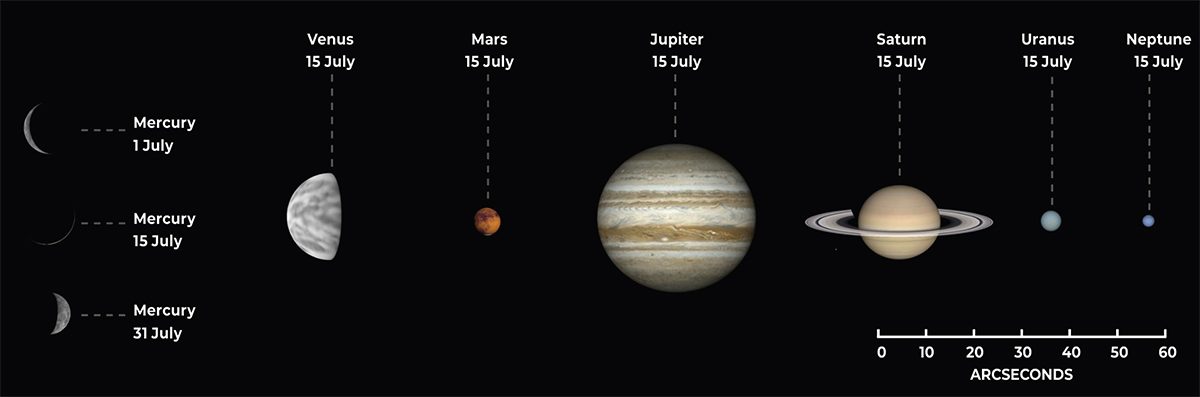
Mercury
- Best time to see: 31 July, 45 minutes before sunrise
- Altitude: 5° (low)
- Location: Gemini
- Direction: East-northeast
Not best placed at the start of July. On 12 July, Mercury is at inferior conjunction, lining up with the Sun on the Earth side of its orbit. After this it re-emerges into the morning sky, rising 90 minutes before the Sun on 31 July shining at mag. +0.6. It may be picked up low in the east-northeast 45 minutes before sunrise.
Venus
- Best time to see: 1 July, 45 minutes after sunset
- Altitude: 10°
- Location: Leo
- Direction: West
Venus will reach greatest eastern elongation on 15 August, 46° from the Sun. You’d think that this favours the planet, but the angle of the plane of the Solar System to the western horizon is becoming shallower, dragging Venus lower in the sky this month.
On 1 July, find Venus in darkening twilight 45 minutes after sunset, around 10° above the western horizon. On 31 July, again 45 minutes after sunset it appears just 4.5° up. It stays around mag. –4.0 all month.
On 9 July, it sits 58 arcminutes north of mag. +1.3 Regulus (Alpha Leonis), visible under darkening twilight. On 17 July, Venus is 4.4° northwest of a 15%-lit waxing Moon, but even this will start to become tricky due to low altitude.
Mars
- Best time to see: 31 July, 04:00 BST (03:00 UT)
- Altitude: 18°
- Location: Taurus
- Direction: East-northeast
Mars is a morning planet, slowly edging farther from the Sun. The mag. +1.3 planet rises two hours and 20 minutes before the Sun on 1 July.
On the morning of 4 July, Mars sits just 9.6 arcminutes from mag. +5.8 Uranus, but the conjunction will be hard to see due to bright twilight. On 11 July, a 15%-lit waning crescent Moon sits just east of the Pleiades, with Mars 7.7° to the east-southeast.
Two mornings later on 13 July, Mars can be seen 5.3° north of mag. +0.9 Aldebaran (Alpha Tauri). By the end of the month, Mars rises three hours and 50 minutes before the Sun.
Jupiter
Jupiter is too close to the Sun to observe this month and is at solar conjunction on 29 July.
Saturn
- Best time to see: 31 July, 03:00 BST (02:00 UT)
- Altitude: 30°
- Location: Pisces
- Direction: Southeast
- Features: Rings, banded atmosphere, brighter moons
- Recommended equipment: 75mm or larger
Uranus
- Best time to see: 31 July, 02:50 BST (01:50 UT)
- Altitude: 17°
- Location: Taurus
- Direction: East
Uranus is best at the end of the month, the mag. +5.8 planet reaching 17° altitude while still dark. A close conjunction with Mars occurs on 4 July, although twilight will make this tricky to see well.
Neptune
- Best time to see: 31 July from 02:30 BST (01:30 UT)
- Altitude: 29°
- Location: Pisces
- Direction: Southeast
Neptune is an improving morning planet, reaching almost 30° altitude under relative darkness by the end
of the month.
Keep us up to date with you planetary observing and imaging by emailing contactus@skyatnightmagazine.com