
New research suggests the Sun may have swallowed a rocky planet early in its history, leaving a detectable mark buried inside our star.
"A planet several times more massive than Earth may have fallen into the young Sun and left a lasting chemical imprint deep inside it," says researcher Professor Mutlu Yildiz, of Ege University in Turkey.
"By modelling the Sun’s evolution and comparing the results with precise observations of its interior, we find that the ingestion of a super-Earth could help explain long-standing differences between standard solar models and observations, including subtle changes in the Sun’s internal structure and its depleted lithium abundance."
More cosmic destruction
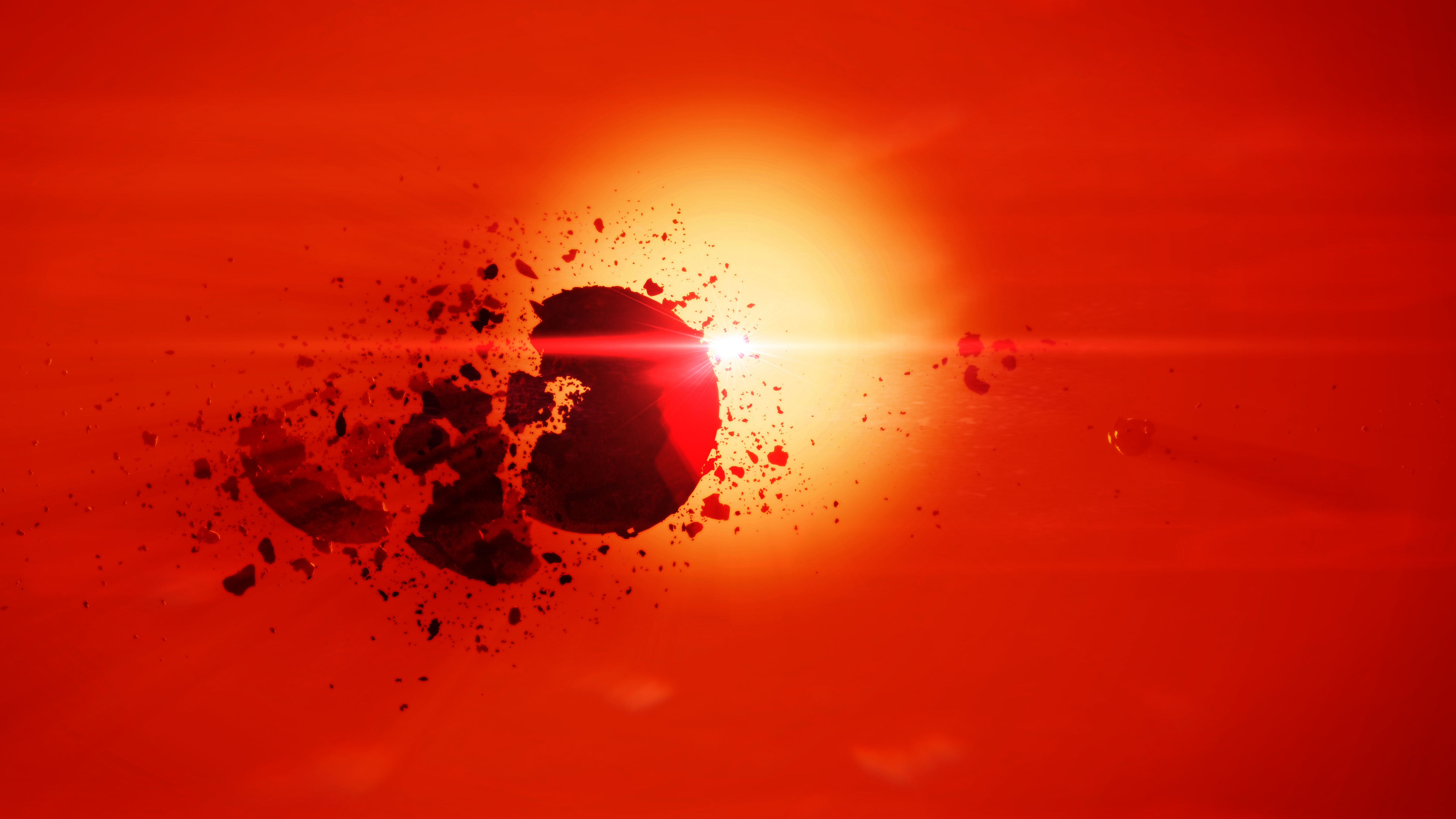
The research team used open-source software called MESA (Modules for Experiments in Stellar Astrophysics) to simulate the life cycles, structure and evolution of stars, modelling different types of material being added to the young Sun.
Their results point to a missing super-Earth-sized planet with a mass of around 5–10 times that of Earth.
The simulations also indicate such a world could have survived its plunge through the young Sun’s outer layers largely intact.
The result does not definitively prove that the Sun swallowed a planet; other explanations could also account for the discrepancies between solar models and observations.
The team’s next step is to determine whether the predicted fingerprints can be independently detected through helioseismology or other observations.

